
Mercaptan (RSH) & COS Removal
Merichem Technologies has proven solutions for removing corrosive carbonyl sulfide in pipelines, process equipment, pumps, vessels and tanks before COS is hydrolyzed into H2S and CO2.
Use drop down menus to refine selections:
AMINEX™
Amine Extraction H2S & COS
Removes acid gas and carbonyl sulfide from LPG-type liquid and gas streams.
AQUAFINING™
Water-based Extraction of Impurities
Extracting soluble impurities from hydrocarbon streams with water.
MERICAT
Caustic Sweetening of Mercaptans
Sweetening of Mercaptans in heavier hydrocarbon streams.
MERICAT II
Caustic Sweetening of Mercaptans
Sweetening of mercaptans in Kerosene, Jet Fuel, Middle Distillates and Diesel streams.
MERICAT J
Caustic Sweetening of Heavy Mercaptans
Sweeten heavy mercaptans contained in kerosene, jet feul, middle-distallate and condensate.
NAPFINING™
Caustic Extraction of Naphthenic Acids
Removes naphthenic acid compounds without emulsions.
REGEN® / REGEN ULS®
Caustic Regeneration
Reduce consumption of caustic by allowing regeneration and reuse of the caustic solution.
THIOLEX™
Caustic Extraction
Removes H2S, acid gases, carbonyl sulfide (COS), and mercaptan (RSH) compounds from liquid and gas hydrocarbon streams.
AMINEX™
Amine Extraction H2S & COS
Removes acid gas and carbonyl sulfide from LPG-type liquid and gas streams.
THIOLEX™
Caustic Extraction of RSH, H2S, COS, & CO2
Removes acid gas and mercaptan compounds from liquid and gas hydrocarbon streams.
REGEN® / REGEN ULS®
Caustic Regeneration
Reduce consumption of caustic by allowing regeneration and reuse of the caustic solution.
AQUAFINING™
Water-based Extraction of Impurities
Extracting soluble impurities from hydrocarbon streams with water.
MERICAT II
Caustic Sweetening of Mercaptans
Sweetening of mercaptans in Kerosene, Jet Fuel, Middle Distillates and Diesel streams.
MERICAT J
Caustic Sweetening of Heavy Mercaptans
Sweeten heavy mercaptans contained in kerosene, jet feul, middle-distallate and condensate.
NAPFINING™
Caustic Extraction of Naphthenic Acids
Removes naphthenic acid compounds without emulsions.
Not Sure Where to Start?
What type of treatment process does each technology use?
Each of our H2S solutions uses a different treatment approach:
- LO-CAT uses a catalytic process that continuously converts H2S into solid elemental sulfur using a circulating, regenerable liquid solution
- SULFURTRAP media is a solid-phase adsorption process, where H2S reacts with iron oxide media to form iron sulfide. Once the media is spent, it’s replaced.
- THIOLEX Caustic Wash is a chemical (caustic) treatment process that neutralizes H2S, and can also remove mercaptans, and COS.
Each process achieves H2S removal through a different mechanism; catalytic conversion, adsorption, or chemical neutralization, and the right choice depends on your sulfur load, gas composition, and operational goals.
Are you treating H₂S in a gas or liquid stream?
LO-CAT: Can be used to treat H2S in virtually any gas stream.
SULFURTRAP: Can be used for treating H2S and light mercaptans in gas and liquid streams.
THIOLEX: Can be used for treating H2S, mercaptans and COS in gases and liquids.
How do I figure out which H₂S treatment technology fits my needs for gas treatment?
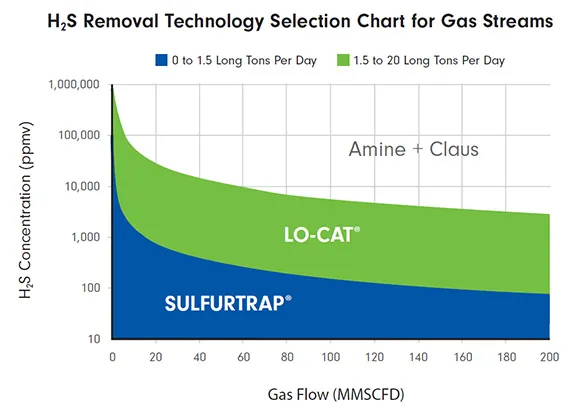
Review our chart below using your gas flow rate and H2S quantity in parts per million to determine what is better for you. Anything in the border area between two solutions can be discussed as there could be economic reasons that affect your decision.
What’s best for smaller or intermittent H₂S loads?
If your sulfur rate is below 1.5 TPD of sulfur or is intermittent, our iron oxide adsorbent SULFURTRAP® is often the most cost-effective. It has a lower capital investment, fast startup and is easy to change out. Adsorbent media can be purchased for your own vessels, or we have a skid-mounted systems for lease or sale.
What’s best for steady or higher sulfur loads?
If your process produces 1.5–20 TPD of sulfur, our liquid redox LO-CAT® technology usually provides the lowest long-term cost.
Still need help?
No problem. Tell us what kind of process stream you’re treating, what you know about the stream and the spec(s) you are trying to meet, and we’ll be happy to assist you!