
FFC Plus™ Technology
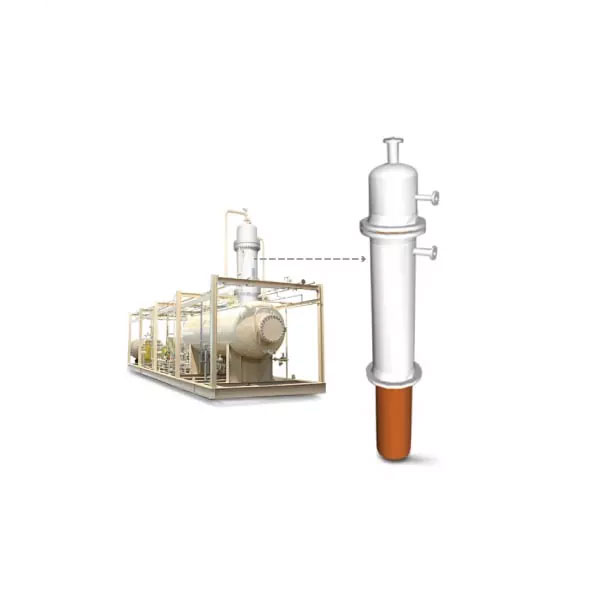
The latest iteration of Merichem Technologies’ FIBER FILM® Contactor technology, FFC Plus™ can increase hydrocarbon treating rates by up to 150 percent as compared to earlier designs.
Learn more about FIBER FILM Contactors
Chemical Products Industries, Inc. is now part of Merichem Technologies
Conventional dispersion and phase separation methods come with a host of problems—lack of turndown capability, plugging, flooding, channeling, long settling times, aqueous phase carryover, plot space requirements, product contamination and unpredictability.
Merichem Technologies’ patented FIBER FILM® Contactor eliminates these problems. Its unique design creates a significantly larger interfacial surface area, using minimum mixing energy, allowing for enhanced microscopic diffusion and a continuous renewal of the aqueous phase. Efficiency of mass transfer is improved by an order of magnitude, reducing operating costs.
Highly adaptable, FIBER FILM® Contactor technology is used in a wide range of caustic, amine, water and acid treatment processes. And our engineers are continually developing new applications to meet our clients’ extraction, oxidation and other treating needs.
With the FIBER FILM® Contactor mass-transfer mechanism, liquid surface area is significantly increased. This improves the efficiency of the process, allowing for higher flow rates with little to no emulsification, carryover or high‑pressure drop during phase transfer.

For over half a century, Merichem Technologies has delivered innovation upon innovation to the oil and gas industry. Our proven solutions for hydrocarbon treatment and caustic management have provided innovative technology and equipment, continuously helping our customers achieve greater performance and profitability.
Complementing our deep expertise is a breadth of capability that includes engineering, design, fabrication, analytics, testing and service support. Merichem Technologies is here to help our customers meet their specifications, performance and warranty requirements.
With extensive capabilities and a flexible array of supply-chain options, Merichem Technologies has helped customers all over the world address some of their most challenging processing and treatment problems.
We have licensed more than 870 FIBER FILM® units worldwide
FFC is the most efficient, non-dispersive contacting device for liquid/liquid or liquid/gas phases for sulfur removal, including H2S, RSH, COS, and CO2. It eliminates aqueous carry-over; therefore, requiring smaller and fewer pieces of equipment, resulting in significant saving in CAPEX and OPEX. Cocurrent downflow operation allows for wide swings in gas/liquid flow rates without interrupting treating or forming emulsions.
RSH needs to be removed for the reduction in total Sulfur and also for its odor and corrosivity to normal carbon steel equipment and piping.
Yes. FFC can accommodate very low and very high flows with high turndown capability. FFCs also have a very low pressure drop so they can fit into systems with limited available pressure drop. Using an FFC can allow large expansions of capacity using existing vessels. Furthermore, FFC PLUS can even double the capacity of vessels while keeping the original size of the existing FFC.
FFCs are comprised of an internal pipe filled with fibers (shroud) inside the larger external pipe (spool) that functions as the pressure vessel. There is a distributor inside the FFC as well.
Yes. FFC as used in THIOLEX systems can reduce total sulfur content to meet specs or fuel standards. In light hydrocarbons streams like LPG, THIOLEX can reduce feed total Sulfur by over 99%. FFCs operate by removing a certain percentage of the incoming impurity, not a defined mass of impurity. The percentage reduction of impurity is determined by the fresh or regenerated caustic addition rate and the circulating caustic concentration.
Spent caustic can be treated and neutralized with Merichem’s MERICON technology by converting it to low COD and non-odor effluent to be disposed in a standard wastewater treating plant. Other options include being taken away by a third party for incineration or deep well injection.
FFCs can be designed with different configurations that allow up to 80% turn-down.
There are minimal footprint requirements since vessels can be as much as 50% smaller than conventional technology. Separation vessels can be set vertically for the smallest spaces.
Depending on the RSH distribution, RSH can be reduced to as low as 2 ppmw.
FC technology design has a wide range of capacity and operating conditions so it can maintain a consistent performance with various feed conditions.
Yes, this is the main strength of FFC technology where a proprietary FFC can be easily installed on most vessels using a standard flange connection with minimal modifications for a significant increase in capacity; therefore allowing tremendous savings on CAPEX.
For well over 50 years.
Merichem typically includes onsite personnel for the commissioning, start-up, and performance test to support any offered technologies. In addition, Merichem offers no-cost phone and email support for the life of the licensed unit.
FFC has no moving parts in the mass transfer portion of the unit. The chemical reactions are simple and the control scheme is straightforward. Co-current flow allows for minimal upsets even when hydrocarbon flows change significantly.
Sweetening is an oxidation reaction that converts mercaptan (RSH) into disulfide oil (RSSR) also called DSO. Sweetening doesn’t lower the total sulfur. On the other hand, extraction is used to remove the sulfur from the HC stream into the treating solution by reacting the sulfur with caustic to create a salt (NaSR) that is soluble in caustic.
Most FFCs can be cleaned in situ using hot water circulation. For extremely dirty services, it may be necessary to remove the fiber bundle from the vessel and clean it manually with low to medium pressure water jetting. FFCs that may be contaminated with pyrophoric iron sulfide can be passivated with a Zymeflow chemical circulation.
Very fine iron sulfide particles, sodium salts or unsaturated hydrocarbons that have been catalyzed to polymerize can foul the fibers in the FFC. Merichem standards require basket type strainers for all the solutions flowing to a FFC to remove the larger particles that can stick between the fibers. Smaller “non-sticky” particles will flow harmlessly through the FFC and will generally settle out in the bottom of the vessel or flow through the system.
The FFC is replaced if the fiber material breaks or degrades or becomes too fouled to properly clean. With normal use (in an alkaline environment) the fiber should last about 15 years or a little longer (typically around three turnarounds). Steamout in the presence of caustic or the presence of acid chlorides can cause stress corrosion cracking of fiber and shorten its life. Chemical cleaning with products containing chlorine compounds (bleach) will damage the fibers and so are not recommended.