Páginas en Español

Chemical Products Industries, Inc. is now part of Merichem Technologies

Talk To An Expert

Our experts are here to guide you.

H2S Removal System | Skid-Mounted Vessels

Continuous Operation | Reliable H₂S Removal | Available for Lease or Purchase

Lead-Lag Vessel System with SULFURTRAP® Adsorbent Media

Our versatile Skid-Mounted Lead-Lag Vessel Systems using SULFURTRAP® adsorbents provide reliable H₂S and light mercaptan removal across oil and gas, biogas, landfill gas, refining, water processing, and other industrial streams.

Designed for continuous operation, these vertical systems use vessels in a lead-lag configuration filled with high-capacity SULFURTRAP adsorbent media. This arrangement maximizes sulfur loading, extends bed life, and allows uninterrupted operation during media replacement.

Unlike biological systems or liquid scavengers, SULFURTRAP Vessel Systems deliver complete H₂S removal without oxygen addition, humidity control, plugging concerns, or continuous chemical injection.

Pre-designed and fabricated H2S removal systems in standard sizes are available for immediate lease or purchase, with custom-engineered designs available upon request. For projects requiring dependable sulfur treatment capacity without a permanent buildout, these vessel systems simplify deployment while supporting stable operation. With minimum field assembly required, they provide a flexible, fast sour gas treatment solution for emergency mitigation, temporary treatment needs, bridge applications, or permanent facility installations. Reliable sulfur removal is maintained even under demanding and changing process conditions.

Typical Reasons Operators Deploy Vessel Systems

  • Meeting pipeline and sales gas sulfur specifications
  • Temporary treatment while permanent facilities are under construction
  • Early production facilities requiring low initial capital investment
  • Emergency H₂S mitigation and upset conditions
  • Renewable natural gas (RNG), landfill gas, and biogas sulfur removal
  • Protection of downstream compressors, treating systems, and process equipment


H₂S Removal Across Diverse Industries & Fluid Streams

Whether deployed as a standalone primary solution or integrated into a complex gas-treating architecture, these skid-mounted systems deliver stable performance across a wide range of operating pressures, temperatures, and fluid compositions.

  • Oil & Gas / Midstream Fuel gas treatment, casing head gas treatment, pipeline off-spec H₂S mitigation, and liquid hydrocarbon (NGL/LPG) sulfur removal.
  • RNG & Biogas Desulfurization Anaerobic digester gas treatment, biogas upgrading, municipal landfill gas, and siloxane/sulfur co-treatment.
  • Refineries & Petrochemical Facilities Treatment of refinery off-gases, light condensate streams, chemical feedstocks, and vapor recovery unit (VRU) streams.
  • Industrial & Wastewater Operations Municipal odor control, industrial wastewater digester gas sweetening, and produced water sulfide removal.

  • Lead-Lag design enables continuous operation, and full utilization of adsorbent capacity
  • Available for lease or purchase
  • Short lead times, with select sizes available immediately
  • Compact, vertical skid design minimizes footprint
  • Built to US Gulf Standards
  • Meets NACE MR0175 requirements
  • Optional upstream knockout drum, downstream fines filter, access ladders & operator platforms
  • Optional adsorbent fill and change-out services available
  •  4 standard sizes available to fit most projects and budgets
  • Custom designs available upon request
  • Media replacement in <1 working shift. Free flowing spent SULFURTRAP® media for safer, faster changeouts
  • Natural gas
  • Landfill gas – LFG
  • Biogas – RNG
  • Acid Gas (CO₂)
  • Syngas
  • Hydrogen gas
  • Offshore gas
  • Amine off gas
  • FWS gas
  • Wastewater gas
  • Blended gas

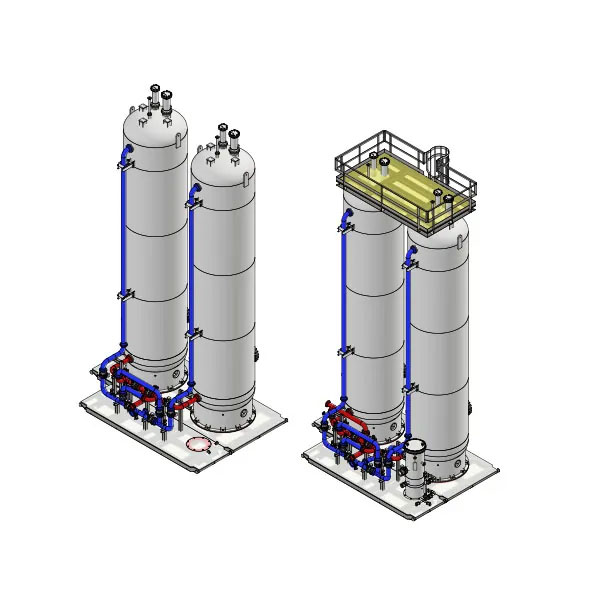
The SULFURTRAP® Skid-Mounted Vessel System has two vertical pressure vessels operating in lead-lag configuration to achieve continuous H2S removal. The sour stream enters the top of the lead vessel passing through both vessels as in a series arrangement. The lead vessel removes the sulfur while the second protects against breakthrough. Once the adsorbent in the lead vessel reaches capacity, the sour feed is redirected to only flow through the lag vessel loaded with fresh adsorbent, while the exhausted lead vessel is placed off-line to perform an adsorbent change-out. Finally, when the fresh adsorbent is loaded in the original lead vessel, the gas flow is reverted with the original lag vessel becoming the new lead vessel.

Merichem Technologies

We can help with H2S Removal System | Skid-Mounted Vessels

Talk To An Expert

or contact us for any questions or concerns.

Lease or Purchase Options to Match Your Project

We offer standard pre-engineered H₂S removal vessel skids available for immediate shipment, as well as fully customized designs tailored to your specifications, allowing you to align equipment deployment with project timelines and budget.

Ideal for Leasing

  • Low capex project preference
  • Temporary or pilot projects
  • Early production facilities
  • Permit-driven or tight deployment timelines
  • Emergency H₂S mitigation
  • Bridge solutions while permanent facilities are built

Ideal for Purchase

  • Permanent gas processing facilities
  • Specialized vessel dimensions or pressure ratings


Paired with High-Performance SULFURTRAP® Adsorbents

SULFURTRAP® adsorbent media provides the high-capacity chemical reaction required for complete H₂S removal under changing field conditions across oil and gas, refinery, petrochemical and industrial facilities. SULFURTRAP® adsorbents are also a reliable desulfurization technology for renewable gas treatment and biogas upgrading systems protecting downstream equipment, reducing corrosion, and improving gas quality.

Key Performance Advantages

  • High sulfur loading capacity: Maximizes run-life between media changeouts, reducing operational costs and spent media volume.
  • Low, stable pressure drop: Maintains stable pressure differential from fresh bed loading through end-of-run saturation.
  • Complete H₂S removal: Delivers outlet concentrations down to non-detectable levels.
  • Handles fluctuating Process Conditions: Reliably processes variable flow rates and inlet concentration spikes.
  • Performs reliably in CO2-rich streams: Maintains effective H₂S removal in high-CO2 environments without wasting bed capacity.
  • Easy and safe media change-outs: Non-bridging media for fast, safe media removal.
  • No oxygen or high relative humidity needed: Unlike biological or air-injected scavenger systems, SULFURTRAP requires no oxygen, moisture addition or high relative humidity to react.
  • Versatility: Effective across a wide range of gas and liquid streams

Explore Adsorbent solutions for gas and liquid streams: Complete SULFURTRAP® Line »

Established Performance

For over half a century, Merichem Technologies has helped clients address sulfur treatment challenges across oil and gas, refining, petrochemical, renewables, and industrial applications worldwide. Proven, innovative technologies, equipment, and service support help our customers improve reliability while meeting sulfur specifications and operational goals.

Comprehensive and Committed

In addition to a range of proprietary treatment technologies, Merichem Technologies offers engineering, design, fabrication, analytics, testing and service support to help clients achieve their specifications, performance and warranty requirements.

Selecting the right H2S removal solution for your operations

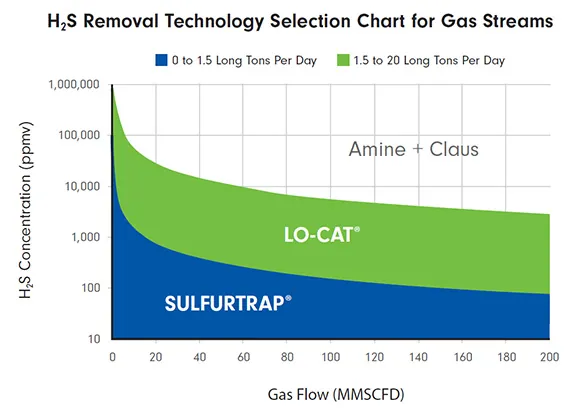
Merichem Technologies has a solution for the H2S present in your streams. The chart offers suggested ranges for our SULFURTRAP® media and LO-CAT® liquid redox technology.

If your flow or H2S concentration is between the two areas, we are happy to help you confirm which system could be most appropriate based on the needs of your operations.

Proven Flexibility, Global Reach

With extensive capabilities and an array of adsorbent options, Merichem Technologies helps customers all over the world address some of their most challenging treating problems.

Frequently Asked Questions