REGEN® / REGEN ULS®
Caustic Regeneration During Mercaptan Extraction Processes
Treatment Solutions
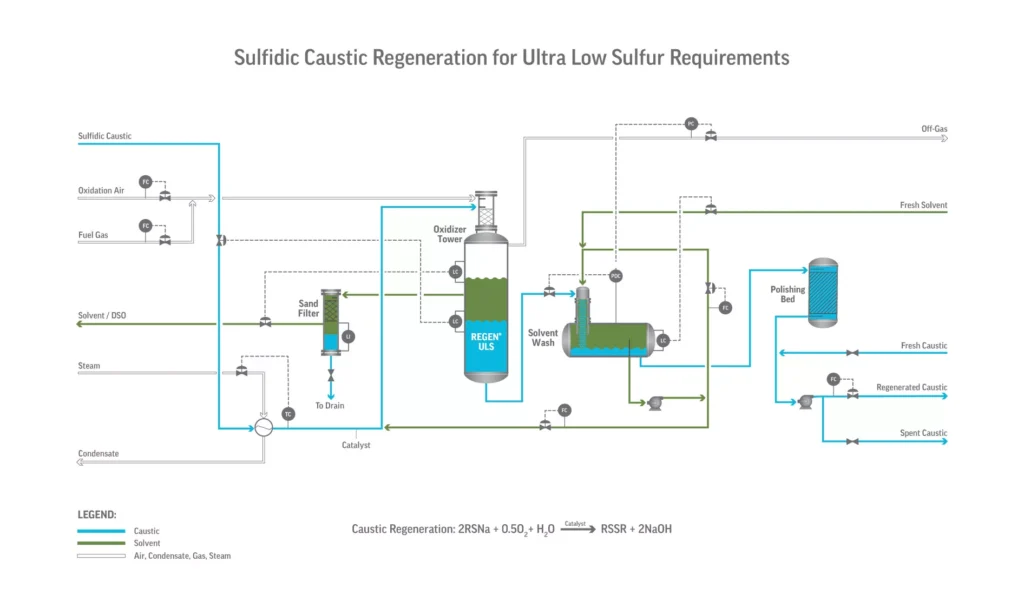
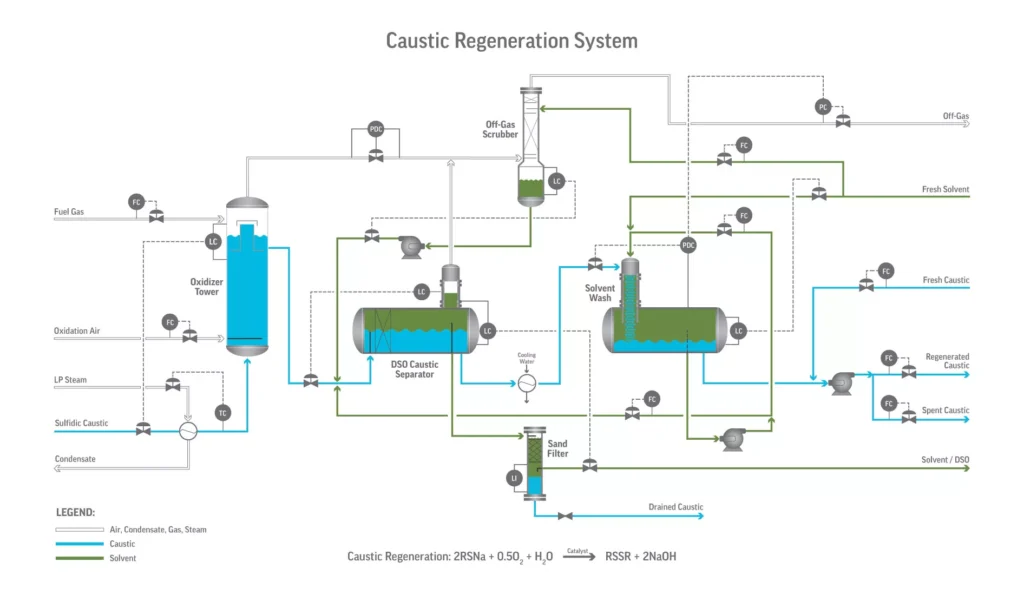
Developed by Merichem Technologies, REGEN® and REGEN® ULS (ULTRA-LOW SULFUR) reduce the consumption of caustic by allowing for the regeneration and reuse of the caustic solution. In this process, sodium mercaptides are oxidized to disulfide oil (DSO), recovering sodium hydroxide for reuse in the mercaptan treating process.
Advantages
- Reduces consumption of caustic by allowing caustic solution to be re‑used
- Mercaptides are oxidized to disulfide oil (DSO), thus recovering sodium hydroxide
- REGEN® ULS allows the return stream of regenerated caustic to have negligible DSO allowing ultra-low sulfur specifications to be met
- Several design options available based on the treatment need
Applications
- All Caustic Streams Used in Mercaptan Removal Processes
How It Works
Coupled with THIOLEX™ technology, REGEN® regenerates the mercaptide-rich caustic purged from the THIOLEX™ system, returning a lean caustic stream for additional mercaptan removal. Depending on the stringency of the treated product specifications, gravity separation and/or solvent washing may be employed to minimize the impact of disulfide oil (DSO) back‑extraction.
Ideal for high-sulfur Coker LPG streams and LPG products requiring <5 wppm total sulfur, REGEN® ULS regenerates mercaptide-rich caustic and returns a lean caustic with minimal DSO content. This results in minimal DSO back-extraction into the LPG and ultra-low sulfur levels in the treated product.

We can help with REGEN® / REGEN ULS®
Talk To An ExpertExtracting Sulfur from Light FCC Gasoline with No Octane Loss
or contact us for any questions or concerns.

Established Performance
For over 50 years, Merichem Technologies has provided innovative technology and equipment to the oil and gas industry. With proven solutions, we’ve helped our customers eliminate the obstacles to performance and profitability.
Comprehensive and Committed
In addition to a range of proprietary treatment technologies, Merichem Technologies offers engineering, design, fabrication, analytics, testing and service support to help our customers meet their specifications, performance and warranty requirements.
Proven Flexibility, Global Reach
With extensive capabilities and a flexible array of supply chain options, Merichem Technologies has helped customers all over the world address some of their most challenging treating problems.
We have licensed more than 170 REGEN® and REGEN® ULS units worldwide
Frequently Asked Questions
What are REGENS used for?
REGEN and REGEN ULS (ULTRA-LOW SULFUR) reduce the consumption of caustic by allowing for the regeneration and reuse of the caustic solution. In this process, sodium mercaptides are oxidized to disulfide oil (DSO), recovering sodium hydroxide for reuse in the mercaptan treating process. The DSO is removed from the regenerated caustic before reuse.
What allows REGEN ULS to provide ultra low sulfur results?
REGEN ULS uses a Merichem proprietary catalyst bed to aid in the removal of disulfide oils (DSO) from the regenerated caustic. Compared to traditional REGEN this dramatically reduces the amount of re-entry sulfur (from DSO) in the treated hydrocarbon stream that is being treated with regenerated caustic for mercaptan extraction.
What utilities are needed?
All REGENs require a heat source such as steam or hot oil, air, fuel gas, and Merichem’s proprietary catalyst. REGENs generate an offgas and a disulfide oil (DSO) stream. The offgas must be incinerated. Some REGENs will require a hydrocarbon solvent stream such as naphtha to remove dissolved DSO to reach very low total sulfur specs.
When is a REGEN needed?
A REGEN is needed when higher amounts of mercaptan (RSH) removal are required and caustic usage must be minimized. Mercaptans are difficult to extract, and so a large flow of caustic may be required to meet downstream hydrocarbon specifications. With a REGEN unit, the large caustic circulation can be recycled back to treat the hydrocarbon stream after the RSH has been removed as DSO, thus minimizing fresh caustic makeup requirements.
Why are there different types of REGEN?
The REGEN’s main job is to oxidize RSH to DSO, and then to separate the DSO from the caustic so the caustic can be reused to lower the total sulfur. There are a few methods for removing DSO from the regenerated caustic: phase separation, solvent washing, adsorption, and stripping. Any of these by itself or in combination with others can be used to lower the DSO concentration to the needed value. Which steps are used depends on how low the DSO must be and if naphtha is available or not. REGEN ULS is a redesigned version of the traditional REGEN that yields the lowest DSO in the regenerated caustic.
Why is catalyst added?
Catalyst speeds up the RSH oxidation reactions so that the Oxidizer Tower size and operating temperature can be reduced. Catalyst is added regularly to the circulating caustic to maintain the proper concentration since it deactivates with time.
How is catalyst added?
All REGENs are provided with a catalyst addition pipe which allows manual addition of the catalyst into the pipe, then flushing the pipe contents into the system. A catalyst injection system (CIS) can also be provided. The liquid catalyst is shipped in 1 gallon jugs for easy addition to the catalyst pipe. Catalyst can also be shipped in a larger tote for CIS systems.
What types of solvent may be used?
Merichem recommends a naphtha or condensate stream with sg of 0.65 – 0.75 containing less than 500 ppm total sulfur. Hydrotreated naphtha is preferred but straight run may used if it is low in sulfur. If naphtha, condensate or kerosene are not available, LPG may be used if there is a destination for high sulfur LPG.
Why is fuel gas added to the REGEN?
Adding fuel gas (FG) raises the total flammable HC content of the offgas above the upper flammability limit rendering it safely non-flammable. Adding N2 instead to dilute the O2 remaining in the offgas requires about 7x the FG flow rate which makes it much more expensive.