ECOTREAT®
Regenerable Catalytic H2S Removal Process Using Produced or Alkaline Water
Merichem’s proprietary, regenerable aqueous-phase catalytic process, converts H2S into stable thiosulfate entirely in solution, eliminating solids formation and the associated risks of plugging, fouling, and downstream corrosion introduced in triazine-based treatment. The catalyst reacts with H2S across multiple active sites and is regenerated in situ, minimizing chemical consumption and reducing operator intervention.
The catalytic process uses produced water or alkaline water as the reaction medium, reducing dependence on freshwater and simplifying integration into existing operations while leveraging available produced water streams. Because the system allows the converted H2S to remain in the aqueous phase as thiosulfate, the disposal path for the water can be downhole with any other produced water stream or be sent to any available wastewater treatment system.
By addressing critical operator challenges, including rising triazine cost and supply, waste disposal, system complexity, and reliability, the technology delivers measurable improvements in uptime, safety, and cost efficiency.
Advantages
- A regenerative process using Merichem’s proprietary catalyst and either produced water or water with added potash or other source of carbonate
- Low-cost OPEX – Significantly lower than triazine, also lower than liquid redox and biological treatment
- Low CAPEX – More economical than comparable liquid redox and biological treating units
- No solid-waste disposal costs or challenges
- Modular – Flexible, pre-engineered, standard design offers low-cost installation and minimal interface
- Efficient – Designed for 99% removal and exclusive selectivity for H2S. Perfect when recovering CO2
- ESG-friendly – Significant reduction of effluent streams
Applications
- Gases at wellhead
- Produced water
- Associated gas
- Amine off gas
- Before custody transfer at pad sites
- At smaller midstream operations
- Where amine or Claus units are impractical
- Anywhere triazine or solid scavenger technologies are uneconomical
- Offshore production facilities
- In lieu of beds/solid media treating
How It Works
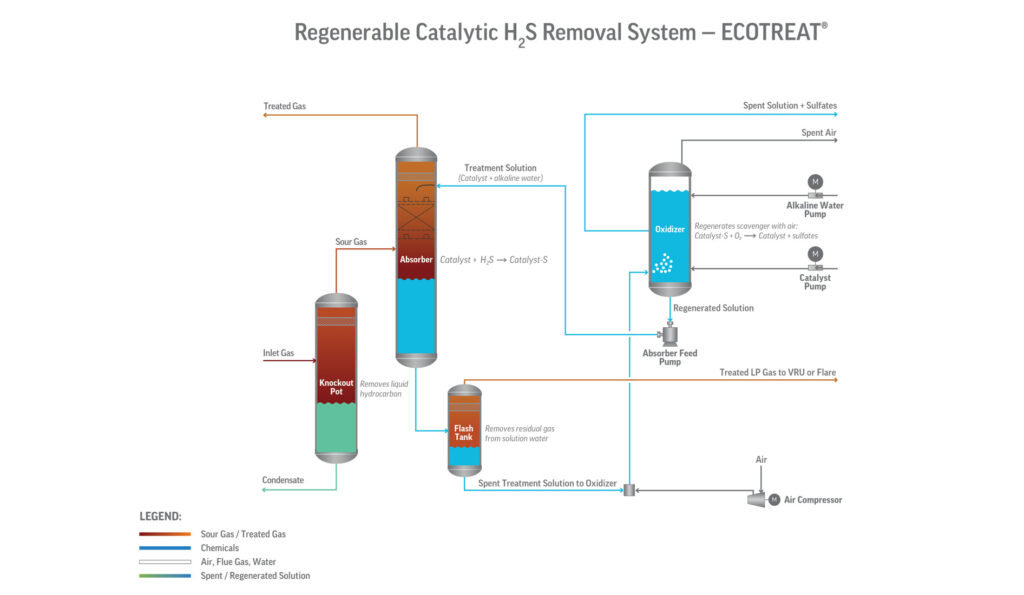
Merichem’s specialized catalyst removes H2S from sour gas, turning it into thiosulfate in the presence of produced water or water with a carbonate source added. The thiosulfate remains in solution while the catalyst is regenerated in an Oxidizer for further use. If produced water is used as a source of carbonate salts, no new chemicals may be needed on site.


History of Expertise
Merichem Technologies has a long history of providing process technology and equipment to the oil and gas and chemical processing industries. Our experience is unmatched, as is our total commitment to supporting our customers.
Capable Problem Solvers
All over the world, we help our customers remove the obstacles to performance and profitability—through engineering, design, fabrication, testing, analytics, technology and services. Our capabilities are comprehensive, and our dedication is total.