
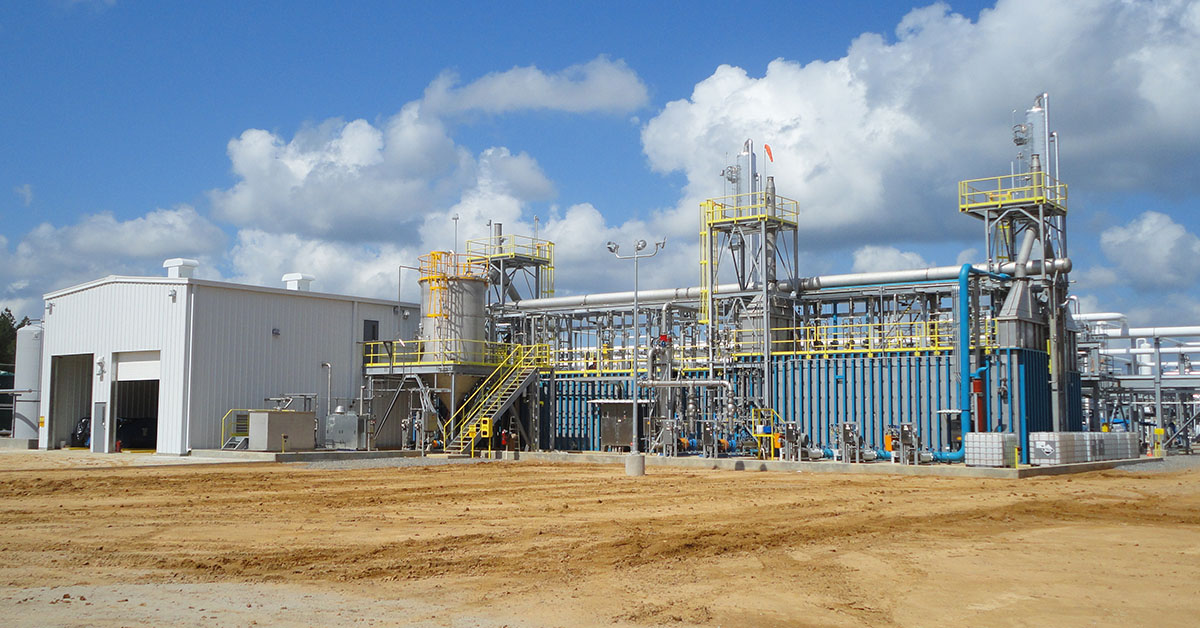
Gas treatment projects often come with firm outlet specifications, shifting feed conditions, and pressure to control long-term operating costs. When hydrogen sulfide levels must be controlled to protect personnel, meet environment and product specifications, and safeguard equipment integrity, operators need a treatment approach that scales with the project without adding avoidable waste or process complexity.
Treatment technology selection depends on sulfur loading, outlet requirements, operating conditions, and the long-term demands placed on the facility.
The benefits of LO-CAT for gas treatment projects are most apparent in applications requiring dependable H₂S removal in a low-to-moderate sulfur range
Why Gas Treatment Projects Need the Right H₂S Strategy
Hydrogen sulfide affects far more than product quality. It can create serious safety risks, corrode equipment, and prevent gas from meeting pipeline, fuel, or process specifications.
For many facilities, gas treatment supports asset protection and helps maintain stable downstream operations. A sound H₂S removal strategy starts with the gas stream itself.
Flow rate, sulfur load, CO₂ content, pressure, temperature, and outlet requirements all shape the treatment decision. Some projects require bulk H₂S removal, while others require polishing before the gas moves downstream.
How Liquid Redox Gas Treatment Works
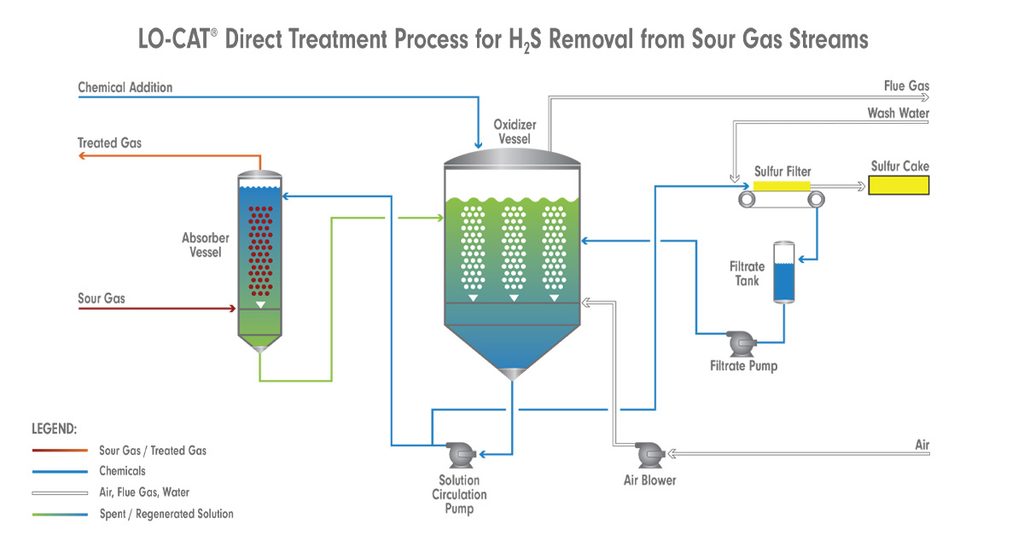
Liquid redox technology uses a circulating solution to absorb H₂S from a gas stream and convert it into elemental sulfur. A chelated iron catalyst drives the reaction.
The process regenerates the catalyst with air, allowing the treating solution to continue removing H₂S. The regenerative chemistry distinguishes this process from non-regenerative treatment media.
In practical terms, a liquid redox unit treats sour gas while recovering the sulfur, yet the treating solution and catalyst remain in circulation rather than being continuously consumed.
This regenerative approach can be particularly valuable when a facility faces sustained H₂S loading.
H₂S Removal with Strong Outlet Control
Gas treatment often hinges on one key question: can the treated gas reliably meet the required specifications? For many operators, outlet H₂S limits allow little margin for unstable performance.
A chelated-iron liquid redox system can efficiently remove H₂S and achieve the low outlet concentrations often required by projects involving pipeline gas, fuel systems, sulfur-sensitive processes, or regulated emissions.
Feed conditions can vary during normal operations and it’s critical to have a treatment system that provides flexibility and reliability. A treatment system capable of adapting to changes provides operators with greater confidence when conditions fluctuate, reducing the need for frequent process adjustments.
A Strong Fit for Low-to-Medium Sulfur Loads
Gas treatment often hinges on one key question: can the treated gas reliably meet the required specifications? For many operators, outlet H₂S limits allow little margin for unstable performance.
A chelated-iron liquid redox system can efficiently remove H₂S and achieve the low outlet concentrations often required by projects involving pipeline gas, fuel systems, sulfur-sensitive processes, or regulated emissions.
Feed conditions can vary during normal operations and it’s critical to have a treatment system that provides flexibility and reliability. A treatment system capable of adapting to changes provides operators with greater confidence when conditions fluctuate, reducing the need for frequent process adjustments.
Better Flexibility for Variable Gas Streams
Many gas streams don’t stay steady for the life of a project. Production profiles change, H₂S levels shift, and flow rates may change over the lifespan of a project.
Gas treatment systems need enough flexibility to keep pace. A liquid redox system can accommodate changing H₂S concentrations and turndown requirements needed by most operators.
That flexibility can help operators avoid overbuilding at the start. It can also reduce reliance on treatment methods that struggle when sulfur load increases or decreases over the life of the equipment.
Flexibility matters even more when a project serves multiple sources or receives gas with a changing composition. In those cases, treatment reliability depends on how well the technology responds to real operating conditions.
A Strong Fit for Low-to-Medium Sulfur Loads
Liquid redox systems can be particularly well suited to gas-processing projects where sulfur loads are too substantial for simple scavenging or adsorption, but do not justify the capital and infrastructure of a Claus sulfur recovery unit.
Scavengers and adsorbents can be practical for low-volume, intermittent or temporary applications, but ongoing consumable costs can increase as sulfur loading rises. At the other end of the spectrum, Claus units can handle larger sulfur volumes but require greater capital investment and infrastructure.
Regenerative liquid redox can suit facilities with either steady or variable H₂S loading, with gas flow rate, and operating conditions helping determine the appropriate treatment approach.
What Happens After H2S Removal
H₂S treatment technologies differ not only in how they remove sulfur, but also in how that sulfur is ultimately managed.
Depending on the chemistry and operating conditions, chemical scavenger systems can generate reaction byproducts that require handling and disposal. Adsorbent systems require periodic replacement and disposal of spent media.
A regenerative liquid redox system takes a different approach by converting H₂S into elemental sulfur. Although the sulfur still requires handling and disposition, operators are managing a recoverable sulfur product.
Operational Advantages That Support Project Economics
Operating costs carry as much weight as equipment cost during gas treatment project planning. Operating costs continue throughout the life of the equipment, so evaluating both provides a more complete picture of system cost. Chemical consumption, waste handling, utilities, and operation requirements can affect the long-term economics of a system.
Operators often evaluate these factors during technology selection:
- H₂S inlet concentration and expected variation
- Required outlet H₂S specification
- Daily sulfur load
- Gas flow rate and pressure
- Available utilities and plot space
- Waste handling requirements
- Chemical and catalyst costs
- Operator attention and maintenance demands
These factors help determine whether a scavenger, adsorbent, amine system, Claus unit, or liquid redox unit makes the most sense. LO-CAT® offers extremely low OPEX compared with other liquid redox technologies, making its ongoing operating costs an important part of overall economics.
Chemical-Based Treatment Without Biological Limitations
Biological treatment can be effective in certain cases but relies on specific conditions for microbial activity. Factors such as temperature, nutrients, pH, gas composition, and operational stability influence its success.
Liquid redox treatment bypasses these microbial dependencies by using controlled chemical reactions to remove H₂S. This provides direct control over the treatment chemistry and avoids the establishment and maintenance of an active microbial population.
Choosing a Gas Treatment Partner
Selecting the right technology is only part of a successful gas treatment project. Technical know-how gathered over decades of experience, proper sizing, process knowledge, commissioning guidance, and operational support can influence project performance.
Whether planning a new facility or reassessing an existing H2S removal program, the right partner can help teams compare options and select a technology that matches the gas stream shaping better performance from the start.
Merichem Technologies can help evaluate gas composition, H₂S loading, operating conditions, and project requirements to determine whether LO-CAT is an appropriate fit and where the benefits of LO-CAT for gas treatment projects can provide value.