
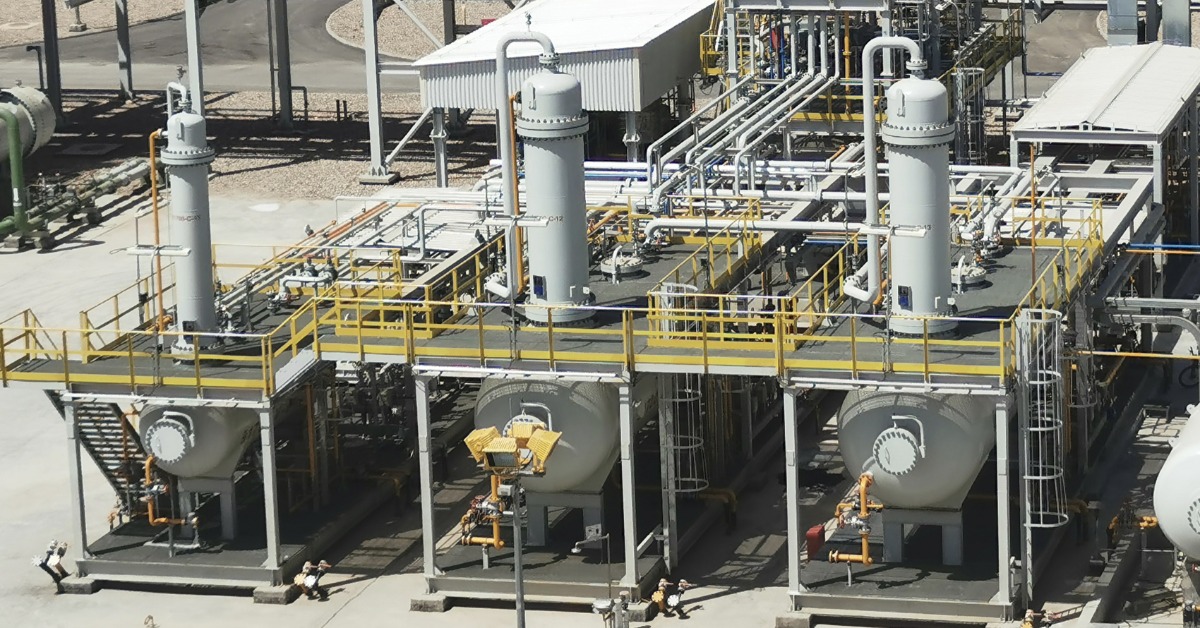
Hydrocarbon processing requires precision. From refining crude oil to purifying natural gas, operators must meet demanding product specifications and environmental standards. Traditional mass transfer technologies, like packed columns or dispersive mixers, have long been the go-to solutions.
However, they often come with significant drawbacks, including large equipment footprints, operational limitations, and phase separation issues that can cause product loss and contamination.
These challenges necessitate more advanced, flexible solutions. That’s why it’s beneficial to take a deeper look at FIBER FILM® Contactor technologies. While widely recognized for superior hydrogen sulfide (H2S) and mercaptan treatment, FIBER FILM® Contactor (FFC) technology offers a far broader range of applications including naphthenic acid removal, COS treatment and water washing to remove impurities. Its patented design provides a robust platform for treating diverse gas and liquid streams, making it one of the most versatile mass transfer solutions available today.
What Sets FIBER FILM® Contactor Technology Apart?
To understand the versatility of FFC, one must first grasp its core design principle: non-dispersive, co-current flow. How does this differ from conventional methods?
Traditional systems rely on dispersion created by vigorous mixing of two streams such as a liquid solvent and a gas or liquid stream. This turbulent mixing increases the surface area needed for mass transfer. However, it can also produce small droplets or even stable emulsions that are hard and slow to separate. This may cause process disruptions, carryover of caustic or amine and require large settling tanks.
Traditional systems also often rely on countercurrent flow between the two streams to maximize staging efficiency. While multi-staging is beneficial in some instances, the negatives of countercurrent flow are larger diameter columns due to slow velocities, limited turn-down capability, potential for flooding, and high carryover/carryunder losses.
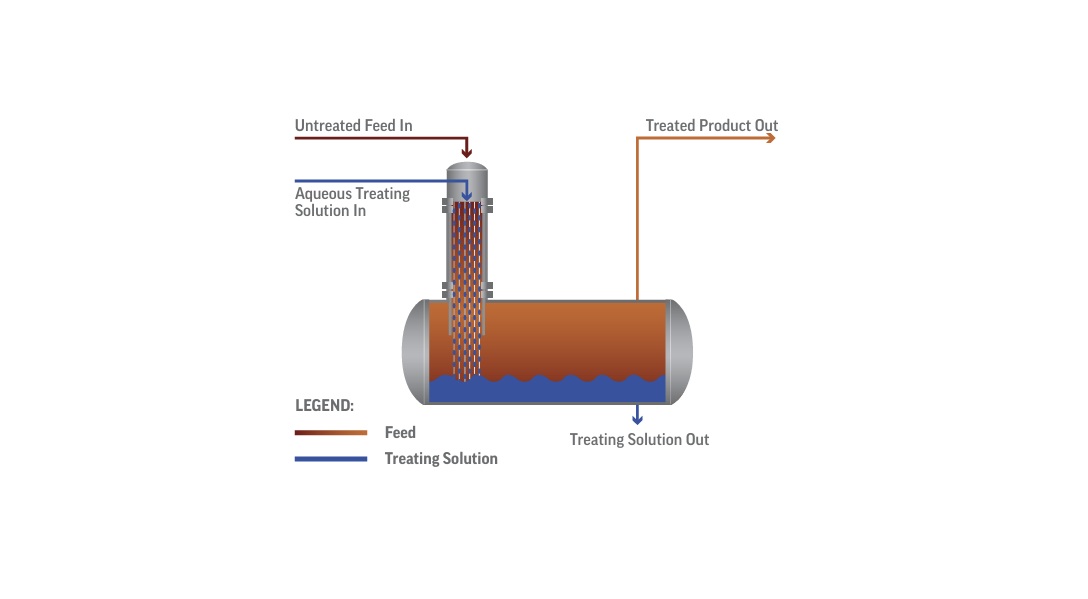
FIBER FILM® Contactor technology avoids both constraints entirely. Inside a FFC vessel, proprietary fibers are arranged vertically. The aqueous treating solution flows downward along the surface of these fibers, creating an ultrathin film. The hydrocarbon phase (either gas or liquid) flows alongside it in the same direction (co-currently).
This innovative, fiber-assisted mass transfer approach delivers three primary benefits:
- Enormous Interfacial Area: The fibers provide a vast surface area for the two streams to interact, ensuring highly efficient mass transfer without forceful mixing.
- Immediate Phase Separation: Since no dispersion is created, the phases separate quickly and cleanly at the bottom of the vessel by gravity.
- Smaller Diameter Columns: The higher velocities allowed by co-current designs directly result in substantially smaller FFC vessels compared to countercurrent towers.
This elegant solution to a complex engineering problem is the key to FFC’s adaptability across a wide array of treatment needs.
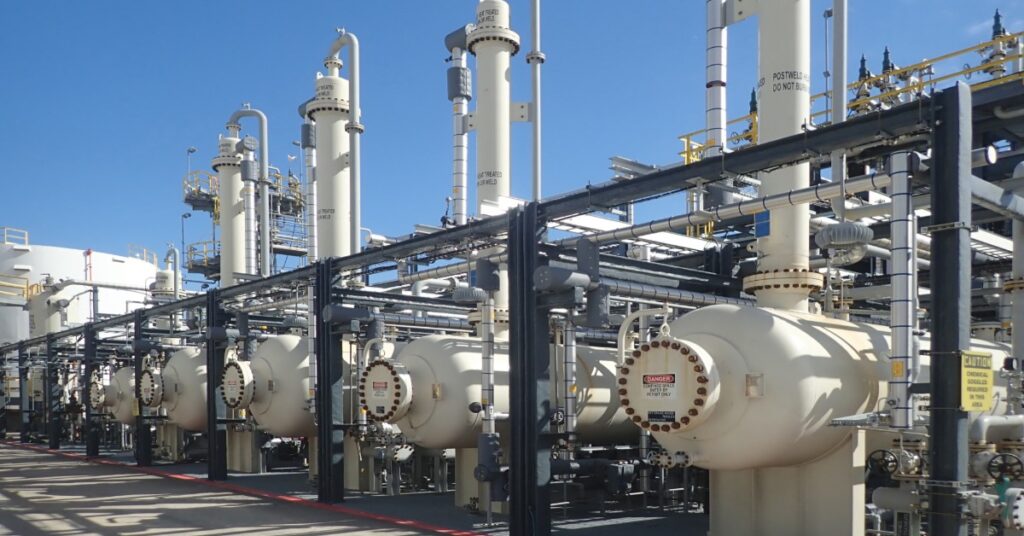
A Multifaceted Tool for Gas and Liquid Processing
FFC technology is equally effective for gas-liquid and liquid-liquid applications, making it a powerful tool for processors handling complex streams.
Gas Phase Applications
In gas treating, FFC technology excels at contacting a gas stream with a liquid solvent to remove impurities. The high-efficiency contact ensures contaminants are effectively scrubbed from the gas, even at very low concentrations. This allows operators to meet stringent pipeline quality or environmental regulations with equipment that is significantly smaller and more reliable than conventional towers.
Liquid Phase Applications
When applied to liquid-liquid systems, FFC technology truly shines. In sulfur treatment and other liquid hydrocarbon applications, treating liquid hydrocarbon streams often poses a high risk of creating small droplets that take a long time to settle or forming stubborn emulsions with traditional mixers. The non-dispersive nature of FFC eliminates this problem, compelling mass transfer between the two liquid phases without the collateral damage of emulsification or excessive settling time.
This results in cleaner products, minimal product loss, and faster processing times, as lengthy settling periods are no longer required.
A Portfolio of Specialized Solutions Built on FFC
The robust, flexible nature of the FIBER FILM® Contactor has made it the foundational technology for a suite of licensed processes, each tailored to address a specific industrial challenge.
H2S and COS Removal (AMINEX™ & THIOLEX™): While FFC is known for H2S removal, technologies like AMINEX™ and THIOLEX™ showcase its full potential in gas sweetening. They use the contactor to efficiently remove H2S, CO2, and carbonyl sulfide (COS), from gas and liquid streams. The high efficiency allows for lower solvent circulation rates and deeper contaminant removal.
Mercaptan Removal (THIOLEX™ + REGEN®): THIOLEX™ efficiently removes light mercaptans (RSH) from gas and liquid streams. Caustic regeneration (REGEN®) systems are usually paired with THIOLEX™ to enable very low caustic consumptions. The pairing of these technologies allows very low total sulfur in the treated hydrocarbon stream. A range of REGEN® designs is available depending on the total sulfur reduction required.
Mercaptan Sweetening (MERICAT™, MERICAT™ II, MERICAT™ J): In many applications, mercaptans don’t need to be removed, but instead converted into less harmful disulfides. This “sweetening” process is perfected in the MERICAT™ family of technologies. Using an FFC unit, these processes facilitate the catalytic oxidation of mercaptans in streams such as condensate, jet fuel, and gasoline, helping products meet strict specifications with a compact, cost-effective system.
Naphthenic Acid Extraction (NAPFINING™): Naphthenic acids in crude oil and distillates can cause significant corrosion issues in refinery equipment. The NAPFINING™ process leverages the superior liquid-liquid contacting capabilities of FFC technology to extract these corrosive acids efficiently, minimizing emulsion formation prevalent in mixing platforms. This upgrades the value of the hydrocarbon stream and protects downstream assets from damage.
Water-Based Impurity Removal (AQUAFINING™): Sometimes, the simplest solvent is the most effective. The AQUAFINING™ process uses water as a solvent within a FFC unit to remove a wide range of water-soluble impurities from hydrocarbon streams. This includes salts and surfactants that could otherwise foul downstream equipment or catalysts. It is an effective and economical polishing solution.
The Overarching Benefits of FFC Adaptability
The versatility of FIBER FILM® Contactor technology is not just an engineering novelty; it delivers tangible economic and operational advantages.
- Reduced Footprint and Capital Costs: By eliminating the need for large settling tanks and tall packed columns, FFC systems are dramatically smaller, reducing installation costs and freeing up valuable plot space.
- Superior Turndown Capability: The co-current flow design is inherently stable, allowing FFC units to operate efficiently across a wide range of flow rates without the risk of flooding or poor performance common in other systems.
- Lower Operating Expenses: High mass transfer efficiency often means that less treating solution or catalyst is required. Furthermore, by reducing carryover to acceptable levels, FFC technology minimizes the loss of valuable hydrocarbon products and expensive solvents.
- Enhanced Reliability: The simple, robust design with no moving parts and resistance to fouling and plugging leads to higher on-stream availability and lower maintenance costs.
Conclusion: A Future-Proof Solution
The ability to adapt to different feedstocks, contaminants, and process objectives makes FIBER FILM® Contactor technology a uniquely powerful asset in modern industry. It moves beyond a single-purpose technology to become a comprehensive mass-transfer platform. By taking a closer look at fiber film® Contactor technologies, operators can unlock solutions to challenges that conventional equipment cannot address efficiently or economically.
Whether the goal is desulfurization, sweetening, or specialized extraction, the underlying principles of FFC deliver unmatched performance. If you are looking to optimize your treatment processes, partnering with an experienced solution provider that understands sulfur-removal technologies is the first step.
To explore customized solutions that can enhance your operational efficiency and reliability, contact Merichem Technologies today.