THIOLEX™
Extracting RSH, H2S, and COS from Liquid and Gas Streams
Caustic Wash for Extraction of Contaminants
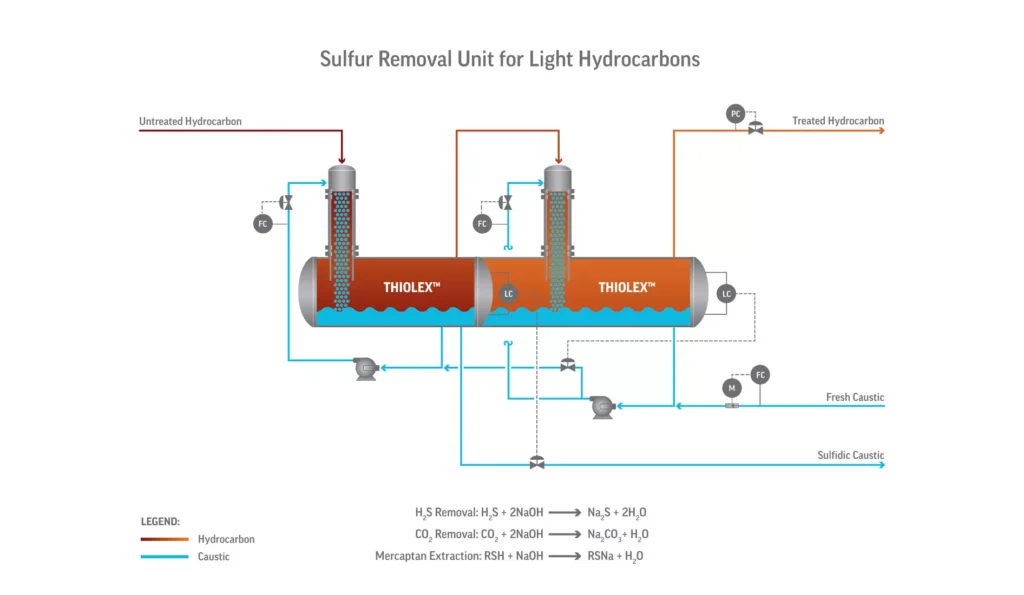
First licensed in 1980, Merichem Technologies THIOLEX™ uses our proprietary FIBER FILM® Contactor as the mass transfer device, with caustic as the treating reagent in liquid and gas hydrocarbon streams.
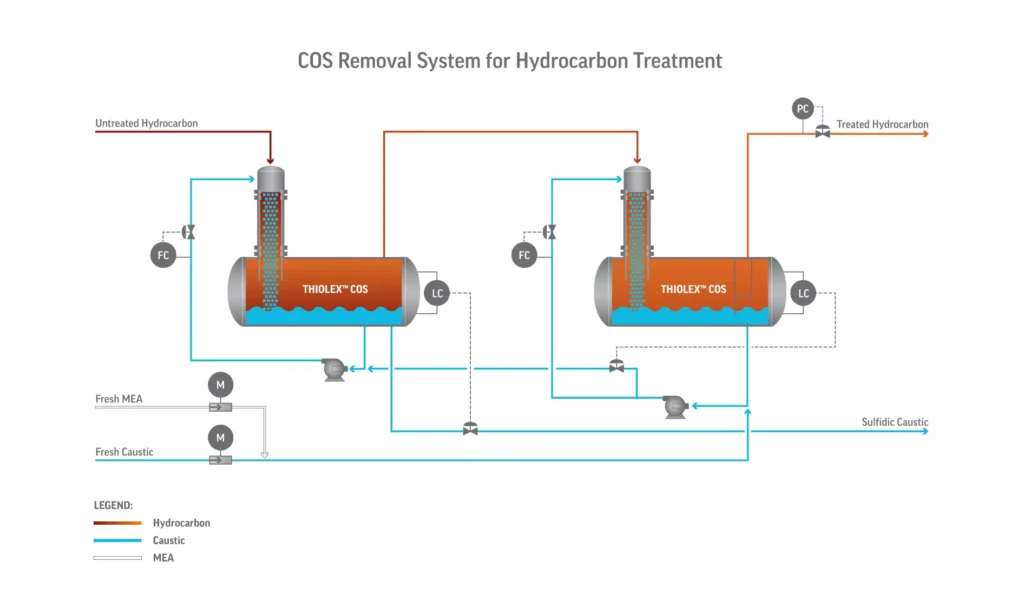
THIOLEX™ technology effectively removes mercaptan compounds (RSH), hydrogen sulfide (H2S), carbon dioxide (CO2), carbonyl sulfide (COS), and elemental sulfur. THIOLEX™ COS, which uses MEA / caustic, is also extremely effective at hydrolyzing and removing Carbonyl Sulfide (COS) to meet a client’s specifications.
Advantages
Combined with the highly efficient FIBER FILM Contactor, THIOLEX™ technology dramatically reduces capital expenditures and space requirements compared to other extraction and treating alternatives.
- No prewash step is required (unless caustic make-up is prohibitive)
- Uses caustic solution to remove impurities
- Low caustic make-up when combined with our REGEN® spent caustic regeneration system
- Total sulfur reduction
- Achieves low total sulfur specification
- Extraction efficiency is best between 60°F to 115° F
- Gives midstream customers more design and operational flexibility to remove H2S and RSH in NGL C3+ streams, increasing sales and profitability
- Excellent and proven technology for removal of sulfur impurities (RSH, H2S, COS); due to high-efficiency mass transfer, additional separation vessels are not required
Applications
- All LPG Streams (Propane, Propylene, Butane, Butylene)
- Acid / Sour Gas
- Off-Gas
- Fuel Gas
- Naphtha
- Condensate
- Crude Distillation Unit
- FCCU or RCCU
- Coker, Visbreaker or Hydrocracker
- NGL
- Gas Production Field
- Oil Production Field
- Oil Sands Heavy Oil Upgrader
How It Works
Because the FIBER FILM® Contactor creates an interfacial surface area that is orders of magnitude larger than conventional processes, THIOLEX™ extraction technology dramatically improves the efficiency of mass transfer, allowing impurities to easily diffuse between phases with little or no emulsification, carryover or high-pressure drop.

We can help with THIOLEX™
Talk To An ExpertAlkylate Wash Unit Upgrades Yield and Increases Production
FIBER FILM® Contactor Technology Opens the Door to Natural Gas Profits
or contact us for any questions or concerns.

A Leader in Caustic Science
Serving the global oil and gas industry for over 50 years, Merichem Technologies is the leader in sulfur removal technology, catalysts and service solutions. Our capabilities span from design and engineering to fabrication and testing.
Solving Tomorrow’s Problems Today
Merichem Technologies combines an unsurpassed breadth and depth of experience with a highly focused commitment to our customers. We listen to them and solve their challenges, often with industry changing innovation.
Proven Flexibility, Global Reach
For over 50 years, Merichem Technologies has licensed its technology solutions all over the world, addressing the industry’s biggest processing and treatment challenges with innovative products and services.
We have licensed more than 250 THIOLEX™ units worldwide
FFC Plus™ Technology

Frequently Asked Questions
What is THIOLEX used for?
THIOLEX removes mercaptan compounds (RSH), hydrogen sulfide (H2S), carbon dioxide (CO2), carbonyl sulfide (COS), elemental sulfur and any other acidic compounds using caustic as the solvent. THIOLEX™ COS, which uses caustic + MEA, is extremely effective at removing COS to meet a client’s specifications. THIOLEX is most often applied for the treatment of liquid hydrocarbon streams but may also be used with gas streams if the gas pressure is high enough to greatly reduce the actual volumetric flow rate of the gas.
Why can’t I just use a mix valve and settler?
Mix valves introduce a lot of high-shear energy into the mixed stream resulting in the formation of many small droplets that become hard to separate in the two phases. Merichem’s FFC minimizes the formation of small droplets by minimizing shear (dP). Caustic is added by a low-pressure-drop distributor at the top of the Contactor. Inside the Contactor, the caustic and hydrocarbon contact each other over the fiber in a very low-shear environment that avoids the generation of small droplets. The fiber material itself also acts as a coalescing medium to remove droplets that still manage to form.