MERICAT
Removing or Sweetening of Mercaptan Compounds in Hydrocarbon Streams
Caustic Sweetening of Mercaptans
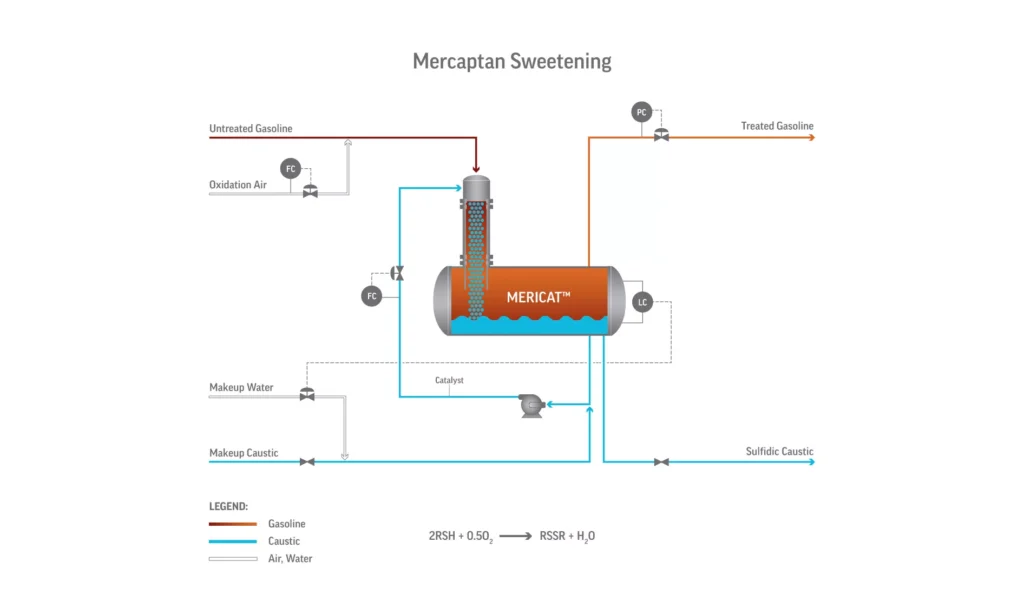
First licensed in 1977, MERICAT™ technology from Merichem Technologies has been successfully used in gasoline/naphtha, condensate and crude oil streams for the sweetening of mercaptan compounds. With our proprietary FIBER FILM® Contactor as the mass transfer device, MERICAT™ uses caustic/catalyst/air as treating reagents.
Advantages
- Converts light mercaptan compounds to less odorous disulfide oils, using a strong caustic to meet mercaptan specifications and pass Doctor tests
- Allows customers to meet pipeline specification requirements for NGL, Y-grade fuels, pentane or condensate
- Simple and proven technology for sweetening light mercaptans in a hydrocarbon stream; a single vessel can achieve the RSH sweetening—no need for additional settling vessels
- Removes odorous RSH with minimal processing to meet total mercaptan sulfur specifications
Applications
- Condensates
- Light Crude Oils
- Naphtha Treating (Gasoline, Alkylate, Raffinate, Straight-Run)
- Gas Production Field
- Oil Production Field
- Crude Distillation Unit
How It Works
Thanks to the dramatic increase in liquid surface area achieved by Merichem Technologies’ FIBER FILM® Contactor, MERICAT™ achieves maximum efficiency of conversion—with little to no emulsification, carryover or high‑pressure drop during phase transfer.


Established Performance
For over half a century, Merichem Technologies has provided innovative solutions to the oil and gas industry, establishing a reputation of expertise in caustic treatment technology and service solutions. Equally uncommon is our dedication to our customers and solving their problems.
Support, A to Z
The depth of Merichem Technologies’ expertise is reinforced by the breadth of its capabilities, which include solution design, engineering, fabrication, research and development, testing and service.
Proven Flexibility, Global Reach
Merichem Technologies has helped customers over the world solve their treatment challenges with proven, industry‑changing technology.
We have licensed more than 150 MERICAT™ units worldwide
Stream Types

FFC Plus™ Technology

Frequently Asked Questions
What is MERICAT used for?
MERICAT oxidizes (sweetens) light mercaptans in a hydrocarbon stream using dissolved O2 and a catalyst in a caustic environment; a single vessel can achieve the RSH sweetening—no need for additional settling vessels. While sweetening light RSH, Mericat also removes H2S and other acids due to the caustic. Total sulfur is not reduced.
Can I use this to extract mercaptans? Why not?
THIOLEX is for extraction of RSH. MERICAT is for sweetening of RSH into disulfide oils (DSO). Sweetening RSH is a simpler and less expensive process than extracting the RSH to lower total sulfur. Typically MERICAT is used in heavier hydrocarbon streams like gasoline or condensate that contain ethyl, propyl, butyl mercaptans that cannot be extracted to sufficiently low levels.
Does this require carbon?
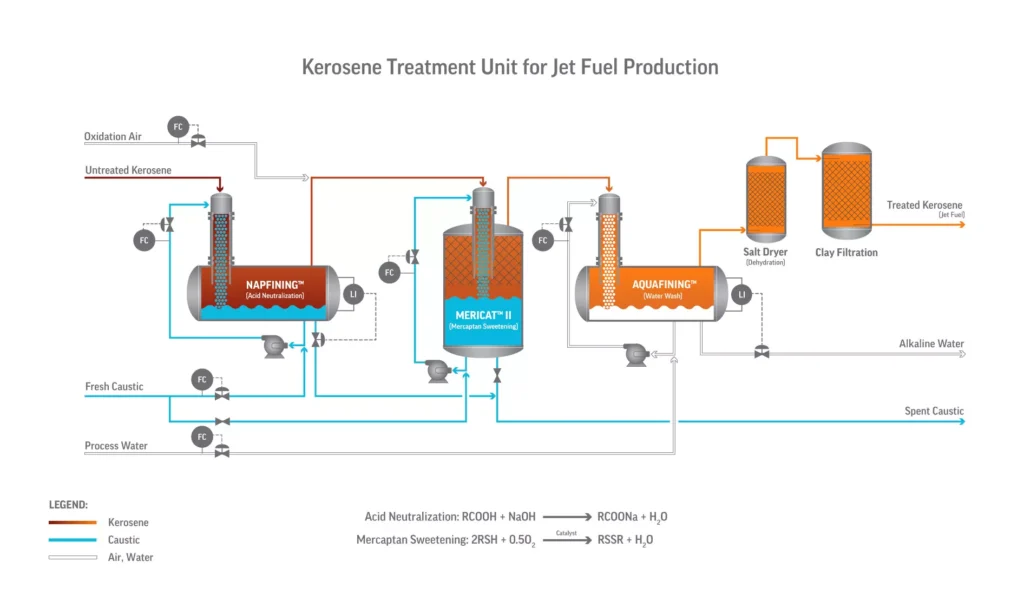
MERICAT is for sweetening light RSH (C1-C4) which do not require carbon. Sweetening of C5+ RSH is more difficult and requires either MERICAT II – with its carbon bed – or the use of MERICAT J with its proprietary solution.
What happens to the air that is added to the MERICAT?
Most of the dissolved O2 is consumed by the oxidation reactions, but some remains along with the dissolved N2. Adding air to the HC stream means that the treated stream will have a higher vapor pressure and may degas if its pressure is reduced – depending on how much air was added. Degassing may carry light HC away and should be considered during the design phase since a flammable off gas can be formed.
Why is catalyst added?
Catalyst speeds up the mercaptan oxidation reactions so that the FFC can be used instead of a larger catalyst bed. Catalyst is added regularly to the circulating caustic to maintain the proper concentration since it deactivates with time.
How is catalyst added?
All MERICAT designs (MERICAT, MERICAT II and MERICAT J) are provided with a catalyst addition pipe which allows manual addition by pouring the catalyst into the pipe then flushing the pipe contents into the system. A catalyst injection system can also be provided.